


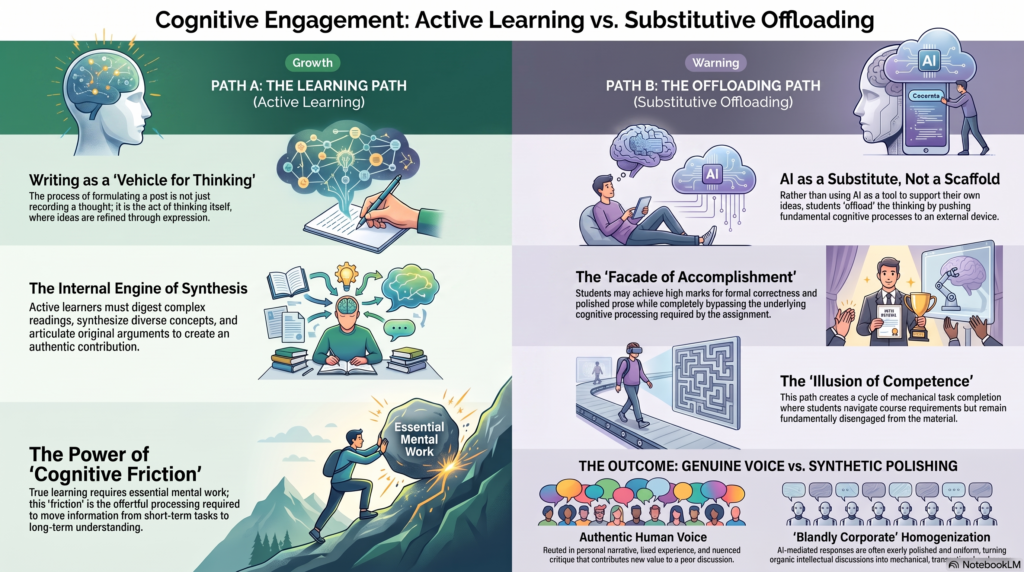
Asynchronous online discussions have long served as important spaces in higher education for social constructivism. These forums encourage critical thinking, peer reflection, and collaborative knowledge building. In recent years, however, the rapid growth of Generative Artificial Intelligence has changed the nature of these interactions. When students rely on Large Language Models to draft their posts, discussion boards often become filled with highly polished and uniform writing that lacks personal experience, individual voice, and thoughtful critique. Francis et al. (2025) warn that this uncritical use of GenAI creates “a distinct danger of cognitive offloading, where the ‘thinking’ is outsourced to the GenAI,” which can weaken student voice and reduce meaningful peer engagement (para. 5). This is often observed in the classroom as many students now believe that summarizing a classmate’s post is what participation should look like. Although Generative AI can support brainstorming and organization, its unexamined use threatens academic authenticity, reduces genuine peer interaction, and raises ethical and equity concerns. These challenges call for intentional prompt redesign and thoughtful pedagogical reform. Structured approaches such as the AAR Method offer a practical way to reclaim online discussions and guide students back toward authentic, student driven dialogue.
II. The Changing Nature of Online Discussion Board Posts
Asynchronous discussion boards were originally designed as collaborative spaces where students could test ideas, ask questions, and refine their understanding through authentic peer dialogue. The integration of Generative AI has noticeably changed the tone and quality of many student contributions. When students use LLMs to generate their posts, the writing often becomes uniform, overly formal, and corporate in style. Although grammatically correct, these responses frequently lack personal narrative, contextual nuance, and genuine student voice. They often become summaries that add little to the conversation. As recent literature on digital assessment notes, “when a student can paste an assignment prompt into Generative AI and get a polished discussion post in seconds, the entire premise of text-based online engagement is compromised, not just the grading, but the learning itself” (VoiceThread, n.d.). As a result, discussion boards can shift from organic intellectual exchanges to mechanical transactions, where students respond to algorithmically generated text rather than to the unique perspectives of their peers.
Beyond stylistic concerns, reliance on GenAI poses a deeper threat to cognitive engagement. Discussion boards are built on the idea that writing is a form of thinking. The act of composing a post encourages students to digest readings, synthesize ideas, and articulate original arguments. When students ask an AI tool to write a response for them, they bypass the cognitive friction that supports learning. Jose et al. (2025) argue that when generative AI becomes a substitute rather than a scaffold, students engage in substitutive offloading. This pushes essential cognitive processes to an external tool and creates a sense of accomplishment without genuine conceptual understanding. Students may complete tasks with formal correctness while remaining disengaged from the course material. Over time, this dependency can create an illusion of competence and allow students to meet participation requirements without meaningful learning.
III. Academic Integrity, Accuracy, and Equity Concerns
Unmonitored use of Generative AI also introduces risks related to factual accuracy and academic integrity. Large Language Models rely on predictive pattern matching rather than factual retrieval. As a result, they often produce hallucinations, invented statistics, and fabricated academic references. Research on citation integrity shows that because LLMs reconstruct references from statistical patterns rather than factual recall, unverified outputs frequently contain phantom citations that blend real author names and journal titles into fabricated sources (Spennemann, 2026). When students use AI generated evidence without verifying it, these fabricated citations enter shared learning spaces. This not only violates academic integrity but also spreads misinformation to peers who rely on discussion boards as collaborative learning environments.
In response to these concerns, many institutions have adopted automated AI detection software. However, relying on detectors introduces significant pedagogical and ethical challenges. Current detection tools have high false positive rates and are not reliable enough for formal disciplinary action. Research also shows that these algorithms disproportionately flag writing produced by non native English speakers and neurodiverse students because of predictable sentence patterns and formal stylistic features (Francis et al., 2025). Attempts to police discussion boards through automated detection can create anxiety and mistrust. They also risk penalizing marginalized students while failing to address the underlying pedagogical issues.
IV. Pedagogical Solutions & Redesigning the Discussion Task
Given the limitations of AI detectors and the prevalence of synthetic text, higher education must shift from punitive surveillance to intentional pedagogical redesign. Initial discussion prompts should incorporate personal context, but peer participation posts are especially vulnerable to superficial compliance and AI delegation. Standard peer replies often collapse into generic praise or automated responses. Lin et al. (2024) observe that integrating Generative AI into asynchronous discussions without structured guidance frequently results in superficial engagement and mechanical task completion rather than meaningful peer dialogue. To restore discussion boards as vibrant spaces for social constructivism, instructors need clear frameworks that guide students toward authentic, human centered interaction.
A practical framework designed for this purpose is the Address, Add, Review (AAR) method. In this model, peer interaction is organized into three deliberate stages.
Address: The student directly engages with a peer by identifying and analyzing a specific argument or point made in that classmate’s initial post.
Add: The student enriches the thread by contributing a personal example or lived experience that relates to the topic. This step encourages alternative solutions or highlights areas where deeper understanding is needed.
Review: The student expands the discussion by referencing course readings or consulting external tools to introduce new insights and perspectives.
The Add step serves as a safeguard for authentic student voice. Because generative AI models do not possess personal consciousness or lived experience, requiring students to ground their responses in real world context prevents complete reliance on synthetic generation. By embedding personal narrative and practical application into peer replies, the AAR method preserves human identity and nuance across discussion boards.
Beyond protecting authentic voice, the AAR framework also redefines the role of Generative AI in online discussions. In the Review phase, students are encouraged to use AI as a sounding board. They can prompt the model to generate alternative perspectives, identify counterarguments, or suggest real world applications related to their peer’s post. Research on AI integration in higher education shows that “structured and reflective AI usage can support deeper understanding, creativity, and intellectual exploration when learners critically evaluate and actively engage with AI-generated outputs” (Hussain, 2026, p.1). When students evaluate and synthesize these AI generated ideas alongside course readings, the technology becomes a tool for inquiry rather than a shortcut for task completion.
V. Conclusion
The path forward requires a shift from technological policing to proactive, human centered task redesign. Frameworks such as the AAR method demonstrate how structured guidelines can revitalize asynchronous participation posts. By asking students to directly address peer arguments and ground their responses in personal experience, the framework protects authentic student voice. At the same time, by encouraging students to use Large Language Models as interactive research partners, the model transforms generative technology into a cognitive scaffold that supports deeper learning.
References
Francis, N. J., Jones, S., & Smith, D. P. (2025). Generative AI in higher education: Balancing innovation and integrity. British Journal of Biomedical Science, 81, Article 14048. https://doi.org/10.3389/bjbs.2024.14048
Hussain, M. (2026). Generative AI and cognitive offloading: Assessing the impact on critical thinking skills among university students: A systematic literature review. https://www.researchgate.net/publication/405373616_Generative_AI_and_Cognitive_Offloading_Assessing_the_Impact_on_Critical_Thinking_Skills_Among_University_Students_A_Systematic_Literature_Review
Jose, B., Joseph, D., Mohan, V., Alexander, E., Varghese, S. K., & Roy, A. (2025). Outsourcing cognition: The psychological costs of AI-era convenience. Frontiers in Psychology, 16, Article 1645237. https://doi.org/10.3389/fpsyg.2025.1645237
Lin, X., Luterbach, K., Gregory, K. H., & Sconyers, S. E. (2024). A case study investigating the utilization of ChatGPT in online discussions. Online Learning, 28(2), 1–23. https://doi.org/10.24059/olj.v28i2.4407
Spennemann, D. H. R. (2026). How Unique Are Hallucinated Citations Offered by Generative Artificial Intelligence Models? MDPI Publications, 14(3), 38. https://doi.org/10.3390/publications14030038
VoiceThread. (n.d.). VoiceThread and AI — Our Position. Retrieved July 26, 2026, from https://learn.voicethread.com/voicethread-and-ai